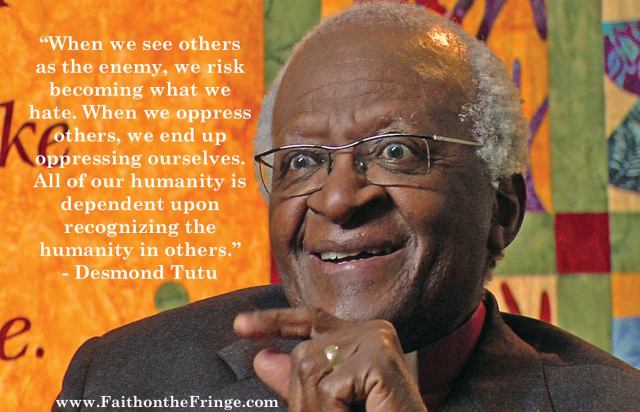
Our humanity

DT_ Faith at the Fringe_o

Posted in images, Quote | Tagged | Leave a comment

No matter the outcome

Olivia Fay quote

Posted in images, Quote | Tagged | Leave a comment

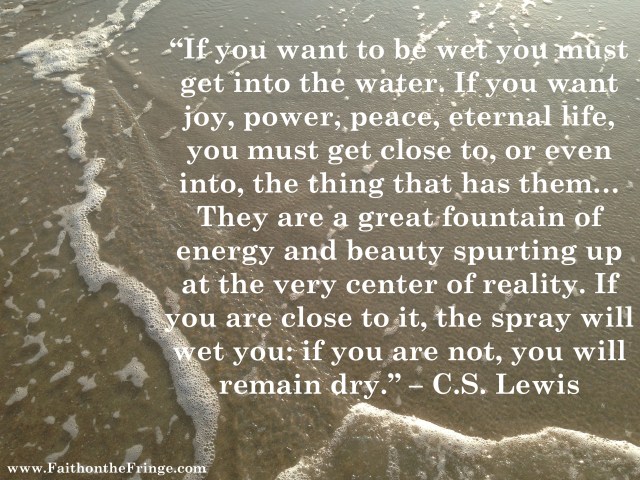
You must get close

CS Lewis water quote

Posted in images, Prayer, Quote | Tagged | Leave a comment

Tim Kaine – A good and faithful servant

While he was Governor of Virginia, I interacted with Tim Kaine on many occasions. Here are a few personal reflections on the faith of Sen. Kaine, the Democratic candidate for Vice President of the United States.

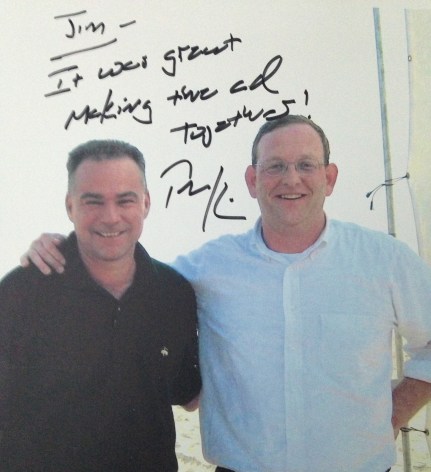
Gov. Kaine and me, circa 2006.

Gov. Kaine and me, circa 2006.

After the Virginia Tech shooting in 2007, Gov. Kaine delivered these remarks at the Tech campus:

“One of the most powerful stories in the human history of stories is that great story central to Judaism, Islam and Christianity – the story of Job from the Old Testament, afflicted with all kinds of tragedy in his family and health, and he was angry. He was angry with his circumstances. He was angry at his Creator. He argued with God and he didn’t lose his faith. It’s OK to argue. It’s OK to be angry. Those emotions are natural as well.

“And finally the emotions of the family members most affected beyond grief, losing a son, losing a daughter, a brother, a sister, losing a close friend. You can go beyond grief to isolation and feeling despair. Those haunting words that were uttered on a hill on Calvary: ‘My God, my God, why hast thou forsaken me?’”

Kaine speaks scripture from the heart as one who knows and believes what he’s saying. His faith isn’t something he uses for political purposes, it’s who he is.

Later in the week of the shooting, during an an interfaith prayer service in Richmond, I was behind the podium when Gov. Kaine stepped to the microphone without notes.

“Lord I believe,” he began, quoting scripture, “help my unbelief.” He went on to talk about the difficulty of maintaining faith in the face of tragedy and horror. He also quoted and applied scripture as though he cleared knew what he was saying.

As Governor of Virginia, he was limited by law to a single, four-year term. One Ashe Wednesday during his time as governor, as I stepped out of St. Paul’s Episcopal Church at the end of the early, mid-day service, I saw Gov. Kaine making his way to the Catholic church across the street, a block from the capitol and his office. He was accompanied only by his two-member security detail. His was a private, faithful, pilgrimage known only to a few. Kaine’s faith is a reflection of his personality – not flashy or brash, but sincere, honest and personal.

On July 21, 2009, I watched Gov. Kaine speak to a group of young people working on a service project in a Virginia State Park.  https://youtu.be/Lev1OnYHLck

In his comments, again speaking without notes, Kaine reflected on the year he took off from law school to do volunteer work in Honduras for the “poorest of the poor.”

He spoke of Jesuit brother Jim O’Leary, who taught him about the value of service.

Kaine said he learned that “if you’re serving others, you’re going to be happy. Your health may be good or bad, your pockets may be full or not. But if you’re serving others, you’re going to be happy.”

Later in life, he learned the reverse is true, too.

“People who aren’t giving and serving, no matter how much they have, or how qualified or talented they are, they’re not happy.”

“The key to happiness in life is pretty simple, I think. Just try to use the modest talents that we all have, and use them for the benefit of others. And if you do that, you’re going to find fulfillment every day of your life.”

After his speech that day, I spoke with Kaine about his faith. Again, he referred to brother O’Leary when he shared with me his idea of living his faith in everything he does.

Sen. Kaine is one of the smartest, sharpest people I’ve met. Ever. His faith isn’t something he bends or changes with his audience or political trends. His faith is who he is. And who is will make a great vice president of the United States.

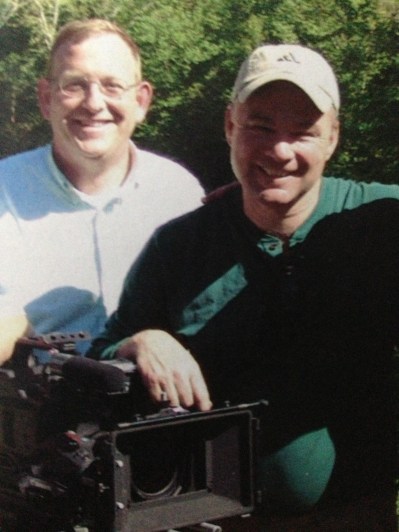
Me and then Gov. Kaine, circa 2007, after directed him in a television commercial.

Gov. Kaine and me, circa 2007, after I directed him in a television commercial.

Posted in culture, Faith, in the news, Uncategorized | Tagged , , , , , | 1 Comment

Right now

IMG_1692

Posted in images | Leave a comment

Understanding Christians in Fowler’s Stages of Faith

Ask a seven year-old what it’s like to be 70.

Get angry when a 16 year-old new driver doesn’t understand how to disassemble a car engine.

Speak with a pair of 15-year-olds about the hermeneutic that informs their theology to determine their eschatology.

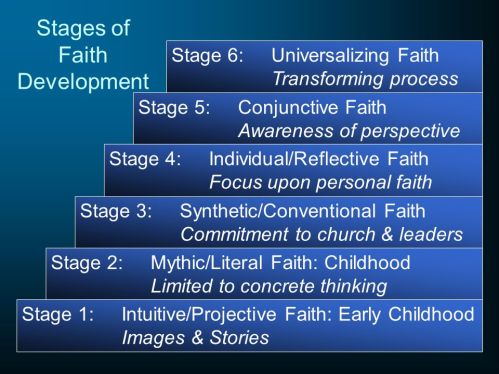
In his book, Stages of Faith, Dr. James Fowler created the theory of the stages of faith development.

Fowlers system

When you squander too much time engaging with people online about issues that are rooted in theology – who their understanding of God is and what God’s message is – it’s likely those people will be completely incapable of understanding what you’re saying.

According to Fowler, people develop faith through certain stages. Their understanding of God progresses, as they progress and grow.

Fascinatingly, humanity’s understanding of God can be seen progressing through the pages of Jewish scripture into the fullness of Christ. God walks through the garden in the cool of the day, God is vengeful, God demands sacrifice, God is unknowable, God can be known through Jesus and the Holy Spirit.

Although the growing understanding of God can be traced through the Bible, some remain fixated on certain aspects of God.

This is because they never progress beyond certain stages.

While Fowler ascribed ages and a timeline to faith development, the simple fact is some college professors, faith leaders and other public officials never progress beyond stage one – stage three. (Think of Franklin Graham, James Dobson, and other literalist fundamentalists.) I’ve encountered a lot of atheists who reject a stage three understanding of God – I don’t blame them, I did too.

Others reach more developed stages of faith development. For example, stage five, “a time when a person is also ready to look deeply into the social unconscious—those myths and taboos and standards that we took in with our mother’s milk and that powerfully shape our behavior and responses. We really do examine those, which means we’re ready for a new kind of intimacy with persons and groups that are different from ourselves. We are ready for allegiances beyond our tribal gods and our tribal taboos. Stage Five is a period when one is alive to paradox. One understands that truth has many dimensions which have to be held together in paradoxical tension.” (Think Tony Campolo and some other Progressive Christians.)

The highest stages are people like the Dalai Lama, Henri Nouwen and some aspects of Pope Francis.

(I believe faith development can occur like Abraham Maslow’s self-actualization – growth in different areas, so that you are more open to faith issues in some areas rather than others. So Pope Francis can be at a stage six in his faith in one area, and yet at another part of his faith believe it’s acceptable to marginalize women of faith.)

Now, here’s the part of Fowler’s book that has been most profound for me – people can only fully understand a stage after they’ve grown through it. They have great difficulty understanding a stage while they remain in it. They have nearly no chance of comprehending, much less agreeing with a stage they’ve not yet reached.

People can’t completely understand a stage that they haven’t yet grown to and they assume their current stage is the highest level achievable. So a stage three Christian assumes he’s the ‘true Christian,’ and is completely incapable of understanding a more complex or nuanced type of faith.

For me, I can see the faith development stage of the Dalai Lama or Henri Nouwen, for example, but my faith isn’t developed to the point where I don’t get angry and curse. Perhaps one day, I will grow to the next stage. But today is a day I curse, and tomorrow looks like it may be a lot like today.

Again, people can see down the stages of faith development, but they can’t see up.

So if someone believes that Christianity and militarization are compatible, they are probably around stage three or stage four. They can’t understand why a stage five Christian opposes militarization.

Stages of faith development explains how some Christians can support guns and advocate for the marginalization of the marginalized.

There’s little point in arguing about sexuality, guns, capitalism, scripture, or other issues that divide Christians, because we simply are talking past each other. Some of us can’t hear or understand others, while others can’t speak in a way that can be understood.

If they were able to understand the aspects of a higher stage of faith development, people would already be at that stage. Trying to communicate with these people is like asking a 15 year-old to explain their hermeneutic.

And we all know how difficult it is sometimes to talk with a 15 year-old.

Posted in culture, Faith | Tagged , , , , , , , , | 9 Comments

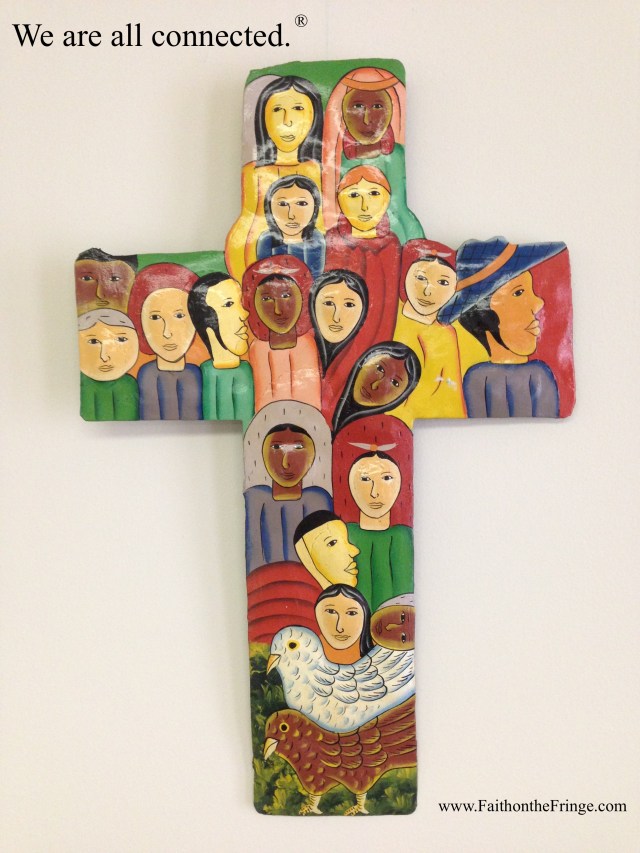
We are all connected

All cross.jpg

Posted in Uncategorized | Leave a comment

They died in vain

This recent mass shooting is a tragedy. The next mass shooting will be a tragedy.

We are sad now, and we’ll be sad the next time. Then we’ll be sad the next mass shooting after the next mass shooting.

Then all of these deaths will be in vain. Their lives and deaths will have meant nothing. And then others will die, too.

We know the future, because we know the past.

The babies died in vain.

Charlotte Bacon, 6

Daniel Barden, 7

Olivia Engel, 6

Josephine Gay, 7

Dylan Hockley, 6

Madeleine Hsu, 6

Catherine Hubbard, 6

Chase Kowalski, 7

Jesse Lewis, 6

Ana Marquez-Greene, 6

James Mattioli, 6

Grace Mcdonnell, 7

Emilie Parker, 6

Jack Pinto, 6

Noah Pozner, 6

Caroline Previdi, 6

Jessica Rekos, 6

Avielle Richman, 6

Benjamin Wheeler, 6

Allison Wyatt, 6

Died in vain.

Principal Dawn Hochsprung and school psychologist Mary Sherlach died in vain, although in her final moments, Sherlach crawled to use her body to block a door.

Teacher’s aide Anne Marie Murphy died in vain, her body covering the body of Dylan Hockley.

Lauren Rousseau and Rachel D’Avino, died trying to protect the 16 babies in their care. One little girl survived.

Victoria Leigh Soto stepped between her students and a semi-automatic weapon with a thirty-round magazine. She helped some of them escape, but died in vain with others.

Babies.

Not grown adults in the fullness of life.

Babies.

Perhaps as the mass shooting numbers inch upwards, Americans will finally pay attention. Finally demand action. Perhaps. Or perhaps not. And they will die in vain.

Perhaps one day parents will no longer have to bury their children, slaughtered at the altar of the gun industry and corporate America.

But the babies will still be dead. And you will still not remember them. And they will have died in vain.

isolated-stone-cross

Posted in Uncategorized | Tagged , , , , | Leave a comment

All, all, are sleeping on the hill

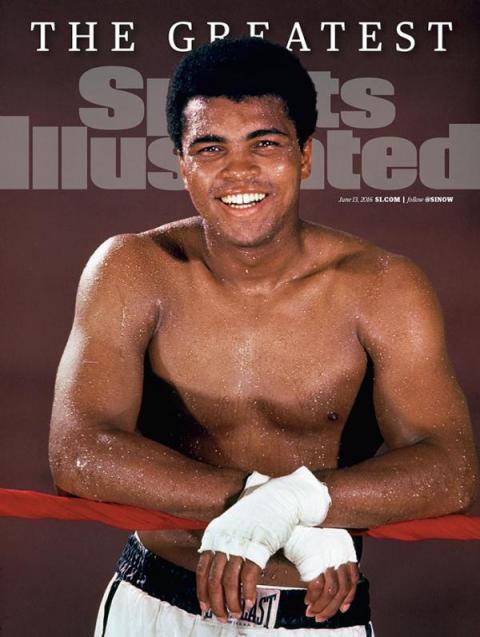
2016-0613-SI-cover-Muhammad-Ali-24COVv12promo

When Muhammad Ali is laid to rest Friday, it will be in Cave Hill Cemetery, in my hometown of Louisville, Kentucky.

At nearly 300 acres, it’s the largest cemetery in Louisville. My mother learned to drive on the narrow, isolated roads. Both of her parents are buried there.

Dedicated in 1848, the cemetery retains the lush landscaping of the Victorian era. Both Confederate and Union solders are there, divided in life, but united again in death.

The cemetery was integrated in 1870, when blacks were finally admitted. Equal in death.

My first trip to Cave Hill was as a pallbearer for my grandfather. I returned often before my grandmother joined her husband there.

Until this week, the best know resident of Cave Hill was Indiana-born Harlan Sanders. You know him as Col. Sanders. So many people were curious to see his final resting place, that the staff painted a yellow line from the cemetery entrance to the grave.
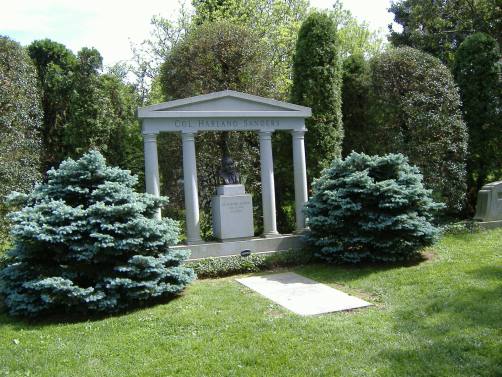
Colonel_Sanders_Grave_1

The resting place of the creator of the Original Recipe.

The line made it easy for me to find my grandparents, walking distance away from the Colonel of Kentucky Fried Chicken. An uncle lies in the other direction, up on a hill.

I haven’t lived in Kentucky since I was four. But for nearly the first 27 years of my life, I returned to Louisville for Christmas and some summers. Most of my family was there.

Both of my parents met Muhammad Ali – my father before he and Cassius Clay graduated high school, my mother after he became Muhammad.

Mom remembers when Walnut Street was renamed Muhammad Ali Blvd. Although Ali was beloved in our hometown, there was opposition to the name change based upon his refusal to be drafted in 1967:

… with a professional record of 29-0, Ali was stripped of all his heavyweight titles when he would not step forward for induction into the armed forces for the Vietnam War.

The Courier-Journal the next day included, at the bottom of the front page, this headline: “Clay refuses induction; to lose boxing crown.”

From the wire service story: “Clay — or as his induction papers said, ‘otherwise known as Muhammad Ali’ — made good his promise not to take the traditional step forward that would have symbolized and confirmed his induction. He said his decision was based on his conviction that he could not remain true to his religious beliefs and serve in the military. He is a member of the Black Muslim faith.”

Ali was arrested, but avoided jail as legal appeals were pursued. Meeting with the press after his induction hearing, for once, Ali spoke not a word, but issued a statement, which read, “I strongly object to the fact that so many newspapers have given to the American public and the world the impression that I have only two alternatives in taking this stand: Either I go to jail or go to the Army. There is another alternative, and that alternative is justice.”

More famously, later, he was quoted as saying: “Man, I ain’t got no quarrel with them Viet Cong, no Viet Cong ever called me ‘nigger.'”

Three years later, the U.S. Supreme Court threw out his conviction.

But during those three years, he would not be able to box. Dundee always reminded reporters that in that time, Ali was in his prime. He lost millions of dollars in earnings. When British interviewer David Frost asked him about that, saying that, “You have thrown away perhaps the greatest sports career since the war,” Ali was indignant.

“I haven’t thrown it away, I haven’t lost it. I would say I turned it down,” Ali said. “See, the greatest sports title means nothing, Mister, if you cannot be free. See? Boys in Vietnam are throwing away, you may say, their lives. I haven’t did that much. I’m still living. They are dying today to free somebody they don’t know. So what the hell is a heavyweight title, and a few stinky dollar bills, for my people’s freedom?”

Ali surrendered his career, because his faith was more important. An elite professional athlete, he was prohibited from earning a living.

His faith remained at the base of all he did, as his fame and reputation superseded his physical accomplishments.

“It was this quality of Ali’s that I have always admired the most: his unique ability to summon extraordinary strength and courage in the face of adversity, to navigate the storm and never lose his way. … This is the quality I’m reminded of when I look at the iconic photo I’ve had hanging on my wall of the young fighter standing over Sonny Liston. And in the end, it was this quality that would come to define not just Ali the boxer but Ali the man — the Ali I know who made his most lasting contribution as his physical powers ebbed, becoming a force for reconciliation and peace around the world.” — President Barack Obama
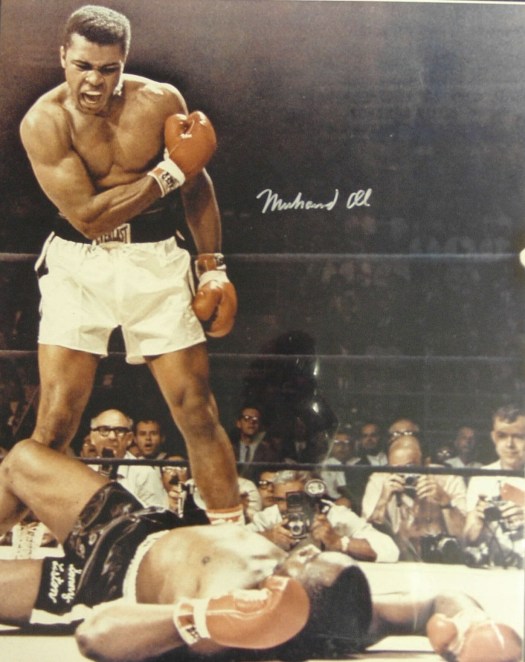
Muhammad Ali showing the world he's the greatest

After years of failing health, now he is gone.

Equal in death, as we all will be.

“Death is the tax a soul has to pay for having a name and a form.” — Muhammad Ali

From the richest to the poorest, from the greatest to the smallest, Christian, Muslim, brown or white, all of us will be claimed by death. Rather than revel in his riches, or strive to make more money with his likeness and reputation, Ali worked as an ambassador to the world. He dedicated his final years to reconciliation and peace.

When I learned he would be buried at Cave Hill, a favorite son returned home forever, I was reminded of a poem.

Spoon River Anthology
Edgar Lee Masters
1. The Hill

WHERE are Elmer, Herman, Bert, Tom and Charley,
The weak of will, the strong of arm, the clown, the boozer, the fighter?
All, all, are sleeping on the hill.

*

Where are Ella, Kate, Mag, Lizzie and Edith,
The tender heart, the simple soul, the loud, the proud, the happy one?—
All, all, are sleeping on the hill.

Sleep well, Champ.

Posted in culture, in the news, Uncategorized | Tagged , , , , , | Leave a comment

Life in our United States

Last week a child fell into the gorilla enclosure at the Cincinnati zoo, and a gorilla had to be killed.

Suddenly the country was filled with zoologists, parenting experts, and people who evidently would feel comfortable with their child in the care of a 450 pound male silverback gorilla.

I watched an unedited news conference of the zoo official explaining the circumstances. (As a communications expert I have a professional interest in watching such interviews.)

My first thought was that if my two-year-old fell into a gorilla enclosure, I would follow my child into that gorilla enclosure.

And then I Goggled Cincinnati zoo gorilla enclosure and saw images of the area.

The barricades appear designed to look natural. A thick wall of shrubbery keeps people away from the edge of a 12 foot drop. The child scampered under the shrubbery, over the edge, and fell into the water below.

I would have attempted to follow my child down that 12 foot drop – at 6’2” I’d be willing to lower myself over the edge, hang and drop a few feet, if it meant protecting my daughter. But looking at the shrubbery, I’m not sure how I would’ve gotten through or over it, to even get to the edge.

And so the facts of the situation changed my opinion of the situation.

But facts haven’t slowed others from having stupid opinions.

We live in a culture of functioning illiterates that eschews experts, but that doesn’t stop us from having opinions. Perhaps it encourages us to have opinions founded on little more than conjecture and bias.

This wasn’t Koko, raised in captivity and learning sign language.

This was a near-wild animal that could have killed the child in a fraction of the time that it took to read this sentence. A wild animal that experts keep a metal fence between them and its kind.

Many may be anthropomorphizing.

The gorilla wasn’t ‘protecting’ the child, like a character from the Jungle Book or a Disney movie, the animal was dragging the child like a toy.

Gorillas in the real world aren't like gorillas in entertainment, or in our minds.

Gorillas in the real world aren’t like gorillas we imagine.

Zoological experts, employees of the zoo trained for exactly this sort of situation, made the decision to shoot the animal and rescue the child.

And yet the internet is ablaze with opinions from people who blamed the parent, faulted zoo officials, and thought they knew better, in the comfort of their living rooms with the benefit of hindsight.

The great thing about the Internet isn’t nearly instant access to huge libraries of information, instead it’s our ability to make uninformed, snap judgments, without consulting any of that information. And then reinforcing our wrong opinion with other ill-informed opinions.

I’m most shocked in this situation by adults who suggest that the animal should have been coaxed with food to surrender the child, or that other methods should have been employed. (Tranquilizers would have been too slow, and the animal would have killed the child if it fell on the child.) The animal could have accidentally killed the child at any moment during the 10 minute ordeal.

I couldn’t imagine the horror the parent must have felt. Evidently, neither can the legions of online experts who blame the parent or think that the child should have remained in the cage longer.

In our egalitarian culture every opinion, no matter how dumb, is just as good as every other opinion.

The opinions of experts, the mildly educated and the ignorant uninformed all have the same legitimacy.

This is life in our United States. It’s what allows our nation to be led into unjust invasions of other countries, to judge parents and zoo officials when the life of a child is at stake, and to vote for candidates with absolutely no experience, expertise or credentials.

I have a Master of Divinity degree.

I have formal seminary training in Biblical studies, which means my reading of scripture often includes a Biblical exegesis of the pericope that incorporates a hermeneutic of historical criticism.

This means my opinion is usually not equal to someone who discussed scripture in Sunday School.

And both of our opinions are less informed than the professors who taught my seminary classes.

The experts – those with formal, legitimate training – are usually right. And they were especially right when it came to making a choice between the life of a child and the life of an animal. It’s baffling to me that there’s even a question. But this is life in our United States.

Posted in in the news | Tagged | 1 Comment

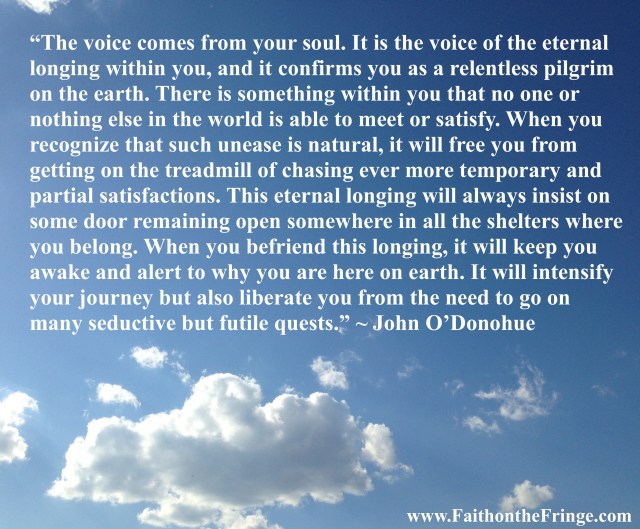
The voice comes from your soul

John O’Donohue

Posted in images, Quote | Tagged , , | Leave a comment

The world is too much with us

When I shared this on Facebook recently,

John O'Donohue

this was one of the comments:

“There were years when this was true for me – why that stopped is beyond me.”

Considering a response, I was reminded of a poem by William Wordsworth:

The World Is Too Much With Us
The world is too much with us; late and soon,
Getting and spending, we lay waste our powers;—
Little we see in Nature that is ours;
We have given our hearts away, a sordid boon!

For many of us, much of our time is spent striving to get back spiritually to who we know we’re supposed to be at our core.

We spend so much energy and time trying to figure out who we are, and then we spend energy protecting who we are from the outside world.

God wants us to be open and receptive and affirming. The world does not. Many Christians don’t either. Perhaps because they are too connected to the world, or too impacted by the world. I don’t know.

People are messy and complicated. Relationships are complicated.

So we move away from others and the love of God, and we turn our backs on opportunities to love others. All for the sake of getting and spending and keeping what we don’t need, because the world is too much with us.

Jesus tells us to be as open and receptive as children. The world tells us to be otherwise.

Let us strive to be less like the world, and more like the love of children and the love of Jesus.

Posted in culture, Faith | Tagged , | 2 Comments

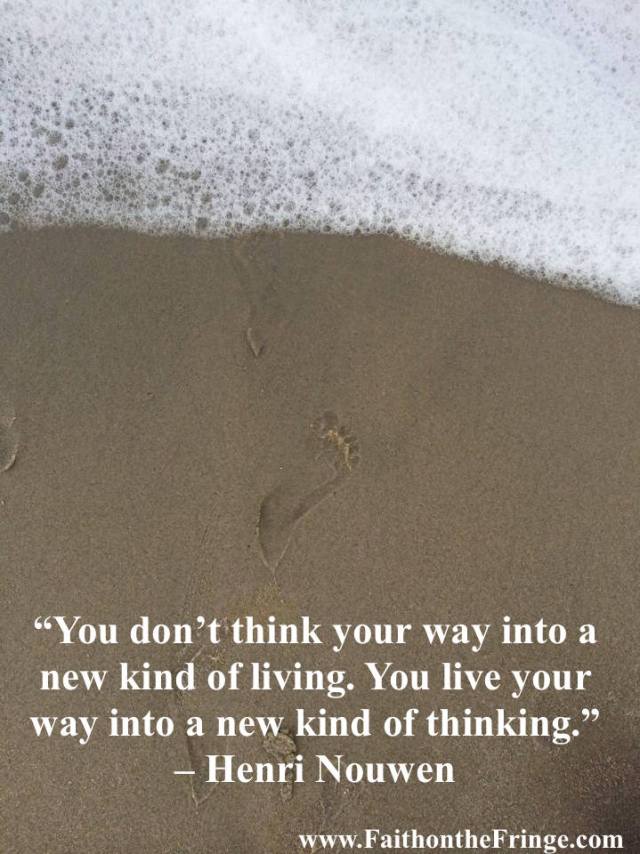
You don’t think your way into a new kind of living

footprints copy 2

Posted in images, Quote | Tagged | Leave a comment

“Both Heaven and Hell”

(Another in my series chronicling my possible return to vocational ministry.)

There’s a church nearby seeking a minister. In the search description, they’re looking for someone who:

“Preaches a balance approach to salvation – both Heaven and Hell – it’s all about eternity.”

Many live in a personal hell they never speak of.

We live in a broken world that falls short of the Divine.

Why would I drag that world  into a place people go to escape it for a little while?

Why remind parents and grandparents who attend church regularly, that their beloved children and grandchildren are estranged from the church and don’t recognize God in the world?

It’s not “all about eternity.”

It’s about living the way Jesus teaches us to live. It’s about following the example of Jesus. If we believe what Jesus says and live the way Jesus teaches — loving everyone the way Jesus loves us — then eternity will take care of itself.

Or, as Jesus says, “Therefore do not worry about tomorrow, for tomorrow will worry about itself. Each day has enough trouble of its own.”


two heads

For more in my series chronicling my possible return to vocational ministry:

Finding a sign

“For sometime, I’ve been prayerfully, seriously considering returning to vocational ministry. My wife and I have talked about it a lot.”

Posted in Faith, Scripture, vocational ministry | Tagged , | Leave a comment