God made me the way I say I am

photo

Posted in images, Quote | Tagged | Leave a comment

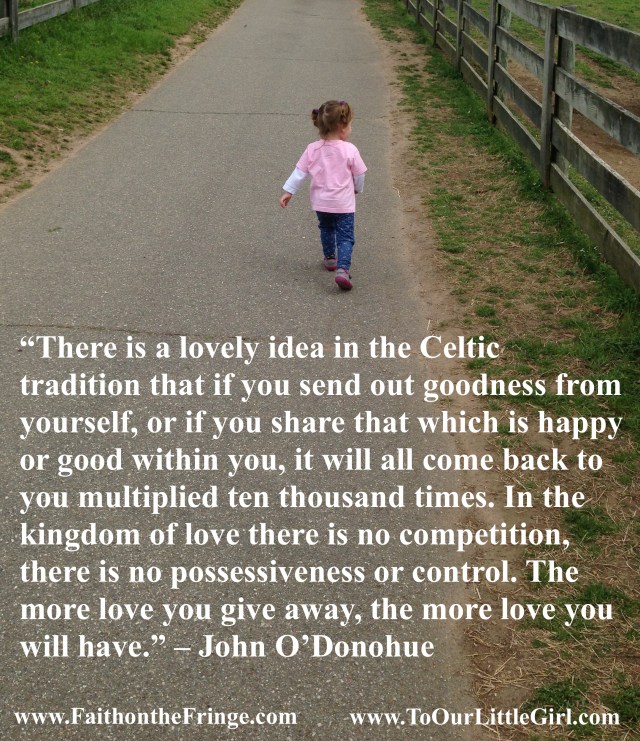
There is a lovely idea in the Celtic tradition

John O'Donohue

Posted in Celtic spirituality, images, Quote | Tagged , | 2 Comments

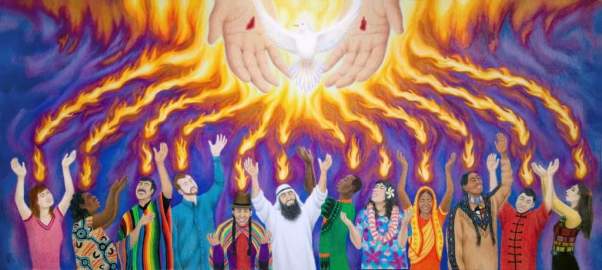
Pentecost

When the day of Pentecost had come, they were all together in one place. And suddenly from heaven there came a sound like the rush of a violent wind, and it filled the entire house where they were sitting. Divided tongues, as of fire, appeared among them, and a tongue rested on each of them. All of them were filled with the Holy Spirit and began to speak in other languages, as the Spirit gave them ability.” — Acts 2.

IMG_1377

Posted in images, Scripture, Uncategorized | Tagged , | Leave a comment

Finding a sign

For sometime, I’ve been prayerfully, seriously considering returning to vocational ministry. My wife and I have talked about it a lot.

Recently I specifically prayed to the Lord to show me a sign, to let me know this is the path I should take. And then a few hours later, I received this e-mail from a co-worker:

sign

I’m in public relations, advertising and marketing. This is a promotional partnership I’m working on. I ordered the design of banners and fliers, but not the large sign in question.

So I asked for a sign, and out of the blue received  the word “sign.”

Ok.

I would appreciate your prayers for my family, for churches that might review my resume, and for me.

Lord hear our prayers.


Posted in Faith, vocational ministry | Tagged , | 2 Comments

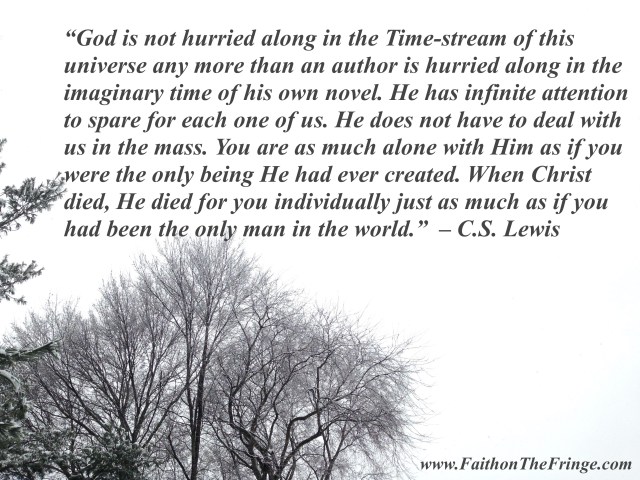
God is not hurried along

IMG_0239

Posted in Quote | Tagged , | Leave a comment

Original sin

The idea of original sin really is original, it’s not in the Bible. It’s a concept conceived by Augustine of Hippo.

Augustine’s original sin says that you’re born a sinner as a result of the sin of Adam and Eve.

Because you’re born a sinner, you need the Church to facilitate your salvation.

Augustine’s concept of original sin served Church leaders well — salvation and connection to God could only be found in the sacraments provided by the Catholic Church.

A lot of Christians believe this, which doesn’t make it true, just commonly believed.

In Genesis 1 humanity is made in the image of God. All of us, men and women. Adam, Eve and the “Fall” from the garden don’t invalidate who we are: the created, in the image of the Creator.

If you’re inclined to focus on sin, then you’ll probably see sin even where it isn’t.

Such was the case for the religious leaders who focused on sin and atonement and constantly worked to gain God’s favor. But Jesus told them their focus was wrong. The focus shouldn’t be on sin, the focus should be on the love of the Creator who made us and who continues to love us.

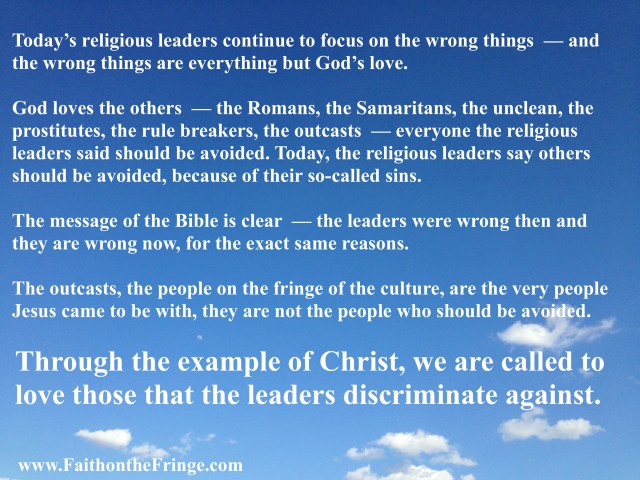
Today’s religious leaders continue to focus on the wrong things — and the wrong things are everything but God’s love.

God loves the others — the Romans, the Samaritans, the unclean, the prostitutes, the rule breakers, the outcasts — everyone the religious leaders said should be avoided.

Today, the religious leaders say others should be avoided, because of their so-called sins.

The message of the Bible is clear- the leaders were wrong then and they are wrong now, for the exact same reasons.

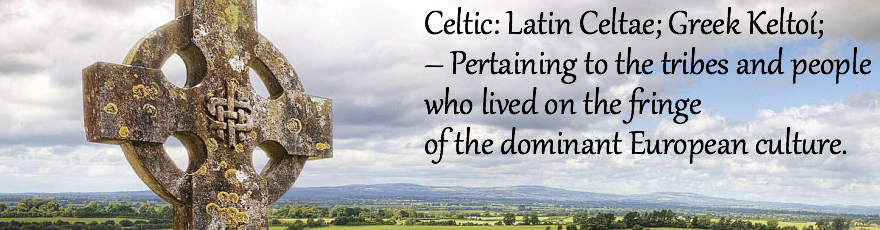
The outcasts, the people on the fringe of the culture, are the very people Jesus came to be with, they are not the people who should be avoided.

Through the example of Christ, we are called to love those that the leaders discriminate against.

Original sin isn’t the sin we’re supposedly born with. The true original sin is turning our backs on the needy, passing laws that strip some people of their rights, and ignoring the examples of Jesus.

Called by God

Posted in Celtic spirituality, Civil Rights, Faith, in the news | Tagged , , , | 2 Comments

More about the Bible

I wrote about the Bible previously. So, this is a little more about the Bible.

A great deal of energy is dedicated to the Bible. A collection of writings that didn’t exist in its current form for more than the first 300 years of Christianity. And for more than 1,200 years after that, the only Bibles were hand-worded in a world with nearly universal illiteracy.

God and Jesus did just fine, for a very long time, without a commonly accessible Bible.

Modern dedication to the Bible reduces the Creator to the pages of a book and moves us further from the presence of the Divine in nature, in ourselves and in others.

Seeking to limit God to a book, a verse, a page, a room, a building or a denomination is an artificial, man-made effort, divorced of the Supernatural. And if God is anything, God is Supernatural. (Gender neutral language doesn’t apply here, because these are man-made institutions, with nearly no women involvement for much of history.)

If you believe that God created everything, forever, so that you will read the New King James Version of the Bible, then you’ve missed the point of Jesus.

Does the God that created bees, and love, and black holes, and rainbows and the deepest yearnings of our soul really care if you read an approved translation of the Bible?

Speaking of translation, in Jewish scripture, God is repeatedly described as “I am.” But that translation can create an impression of permanence, or worse yet, stagnation. A better translation is “I am becoming” or “I am becoming what I am becoming.” This more accurately reflects scripture and it describes a God of creation and movement, more powerful than a building, book or denomination.

Like the changing seasons and the natural world, each of us is busy being born, growing, flourishing and decaying. Like God and the world, we aren’t created to remain unchanged like a church dogma, doctrine or creed.

This is the deeper message of the Bible and of the Celtic Christian tradition — We were born to be reborn, to grow and flourish throughout every stage of life. We are to become, just like the God who created us.

The message of the Bible is that God is calling us to become who God created us to become. This is more important than any church or theology or interpretation of the Bible.

Bible

Posted in Celtic spirituality, Faith, Scripture | Tagged , , , , | Leave a comment

The Bible

The Bible is a collection of 66 (or 73) different books, some history, some poetry, some songs, some letters, as well as the rules of an ancient religion . . . written over the span of 1,600 years. Problems arise when people can’t tell one from another, and confuse them into each other.

Problems arise when you try to take a rule written for and by a certain group of people, and apply it to your life today (taking your disobedient child to the gates of the city to stone him, for example).

Some people believe in Biblical inerrancy – the idea that the Bible is “without error or fault.” This idea has only been around since the mid 1970s. They say the inerrancy is in the original manuscripts of the Bible, but there are no original manuscripts remaining, just copies of copies of copies of copies – but there are a lot of those copies. When people say the Bible is inerrant, they demonstrate they either don’t understand what they are reading, aren’t reading very closely or critically, or are simply lying to themselves.

(I’ve never encountered someone who believes in the inerrancy of the Bible who’s reading it in anything other than English. I don’t believe they’re reading the Septuagint – the Greek translation, the Latin Vulgate or the Hebrew Tanakh. For this reason, the idea of a Bible without error is simply ridiculous.)

People tend to focus on the words in the Bible, and miss the message behind the story. The creation story of Genesis 1 and 2, for example, are poetry, the message is that God is powerful, neither of which is a history lesson.

Adam and Eve is a metaphor — not literal history. It’s poetic parable – an origin story, not the literal story of two people, for example.

The Bible is a fantastic collection of writings by, about, and for the followers of the God of Abraham, and the followers of Christ.

Translations

There are many translations available, Unless you’re used to reading Middle English like Shakespeare, I would avoid the King James Version.

The King James version of 1611 is based on the Geneva Bible of 1560. A lot has been learned since 1611, (the Dead Sea Scrolls found in 1948, for example) that didn’t inform the translators of 1611, and the KJ version has major translation problems. It was reprinted in 1622 to correct hundreds of mistakes.

In the beginning was the SpiritWhy are there so many KJV out there today? The KJV isn’t copyrighted, and is free to reprint and sell.

Even the New Revised King James Version is pretty poor, despite being significantly revised so that it would be eligible for a new copyright. There’s also the New American Bible, the New Revised Standard Version and the New American Standard Bible or the New International Version and the New Living Version. (If the United States Copyright Office, a part of the Library of Congress, believes that a Bible version is so different from previous versions, that it’s eligible for copyright, how inerrant can it be?)

The Bible as God’s Word

Of course the Bible isn’t THE WORD OF GOD . . . it’s translated into a language we can understand – Jesus didn’t speak English when he was walking around Capernaum, for example.

But the Bible is God’s Word . . . meaning the message, not the medium or the method, is what God tries to tell us.

Don’t worry about what the Bible says, worry about what God says to you. God speaks to us through scripture, but God also speaks to us in many, many other and different ways.

The last thing non-believers need is a so-called Christian telling them they need to believe every word of the perfect Bible, (including the provision of taking our unruly children out to the gates of the city and stoning them to death.)

If God wanted the Bible to be the Truth and perfect wouldn’t it be more clear? Jesus spoke in parables because he wanted us to learn for ourselves, not blindly accept what we are fed. And unless we’re reading the Pentateuch in Hebrew and the Septuagint in Greek, we English speakers have really no idea what the Bible really “says.”

Look at Jesus’ ‘last words” on the cross, for example. Different Gospels give him different words. Did he say all of those words at one time? Or did different witnesses hear different things? Does it matter? It doesn’t matter to me what exactly he said. It matters what he did . . . . resurrected three days later and was witnessed by hundreds of people.

IMG_9298 copy

Posted in culture, Scripture | Tagged , , , | 6 Comments

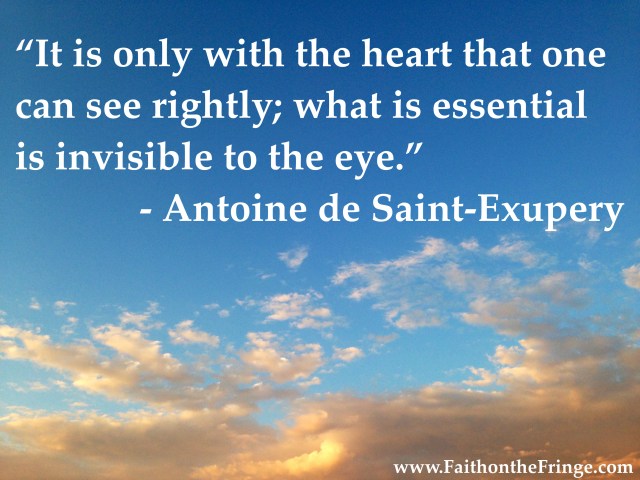
“It is only with the heart that one can see rightly”

Only with the heart

Posted in images, Quote | Tagged | Leave a comment

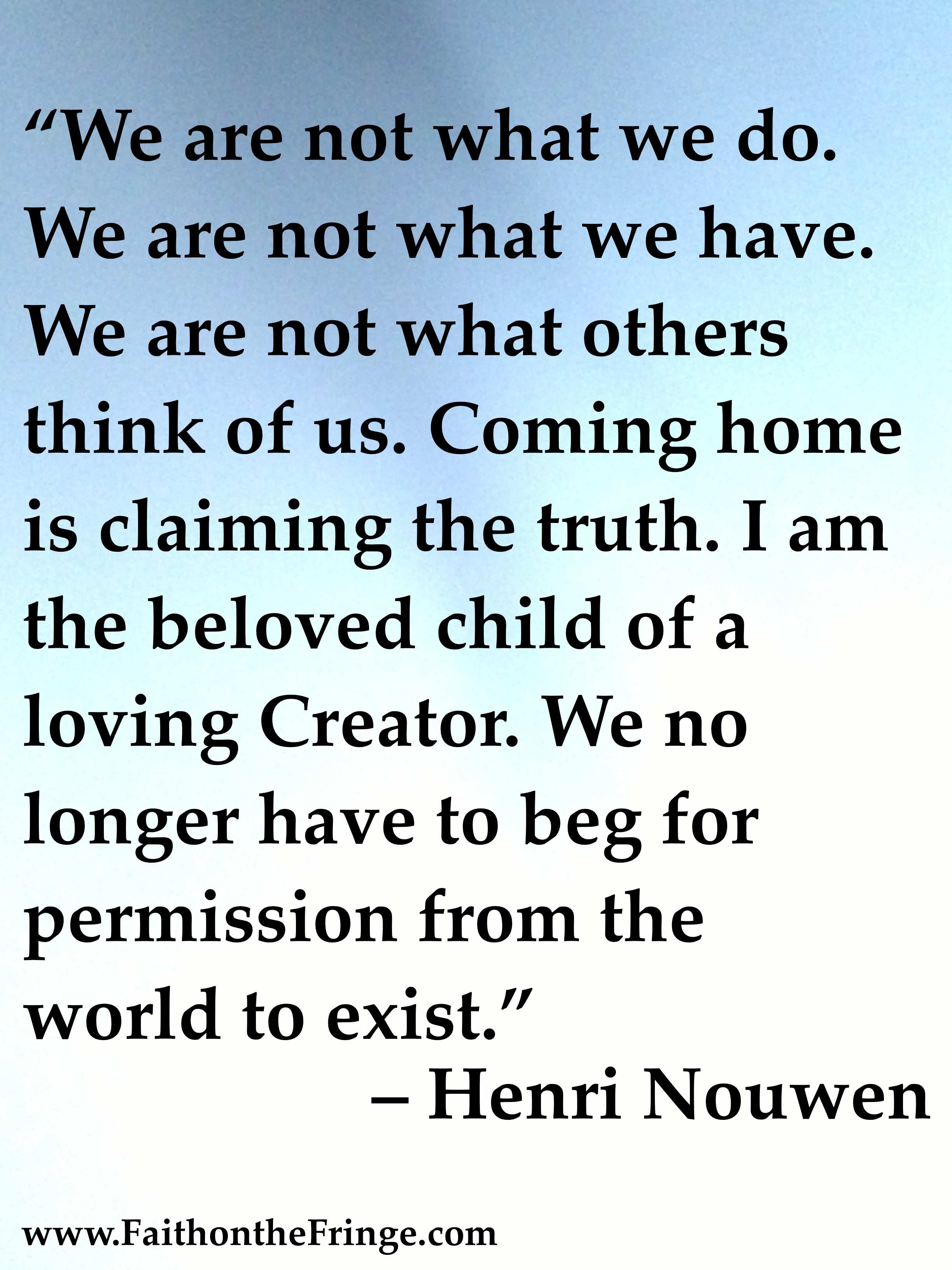
“We are not what we do”

– Henri Nouwen

Posted in images, Quote | Tagged | Leave a comment

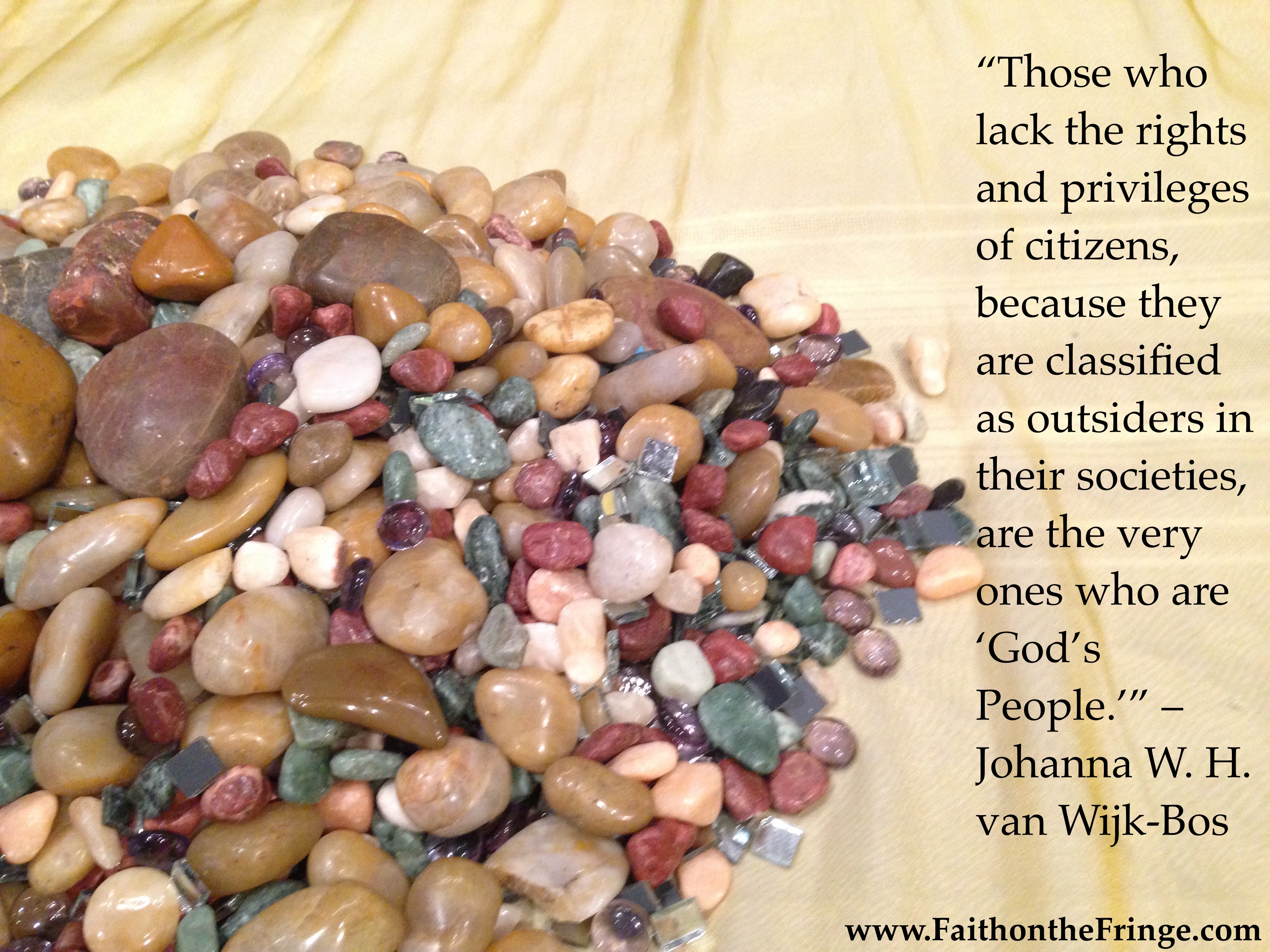
“God’s People”

Johanna van Wijk-Bos

Posted in images, Quote | Tagged | Leave a comment

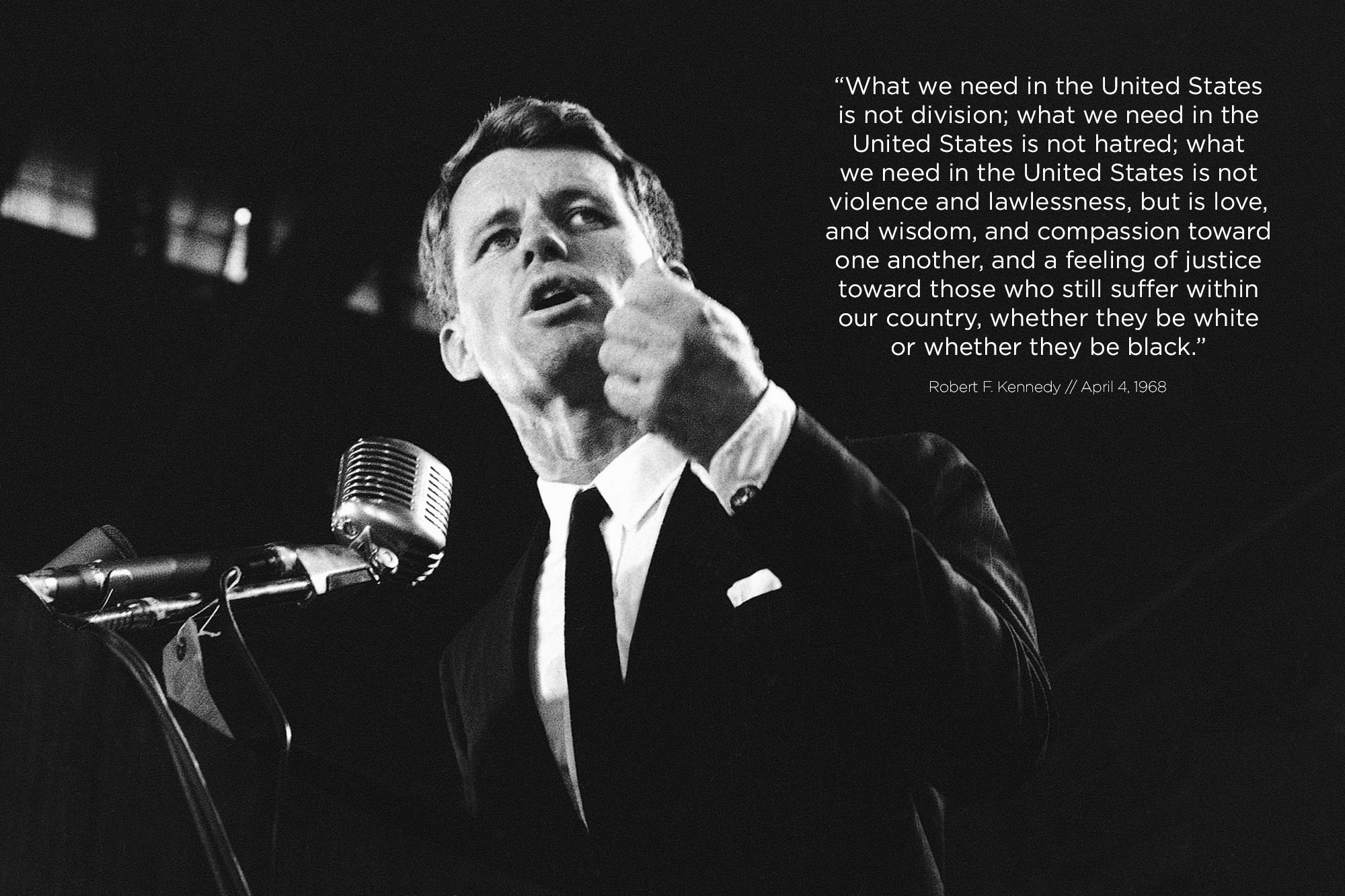
“What we need in the United States”

RFK

Posted in Civil Rights, images | Tagged , , | Leave a comment

“To make gentle the life of this world”

April 4 marks the 48th anniversary of the death of Martin Luther King Jr.

King has been dead nine years longer than he lived.

Every year, I revisit the response of Robert Kennedy in Indianapolis, Indiana, following the assassination. This is one of the finest spontaneous speeches in history.

Robert Kennedy in Indianapolis, Indiana, April 4, 1968.

Robert Kennedy in Indianapolis, Indiana, April 4, 1968.

Ladies and Gentlemen,

I’m only going to talk to you just for a minute or so this evening, because I have some — some very sad news for all of you — Could you lower those signs, please? — I have some very sad news for all of you, and, I think, sad news for all of our fellow citizens, and people who love peace all over the world; and that is that Martin Luther King was shot and was killed tonight in Memphis, Tennessee.

Martin Luther King dedicated his life to love and to justice between fellow human beings. He died in the cause of that effort. In this difficult day, in this difficult time for the United States, it’s perhaps well to ask what kind of a nation we are and what direction we want to move in. For those of you who are black — considering the evidence evidently is that there were white people who were responsible — you can be filled with bitterness, and with hatred, and a desire for revenge.

We can move in that direction as a country, in greater polarization — black people amongst blacks, and white amongst whites, filled with hatred toward one another. Or we can make an effort, as Martin Luther King did, to understand, and to comprehend, and replace that violence, that stain of bloodshed that has spread across our land, with an effort to understand, compassion, and love.

For those of you who are black and are tempted to fill with — be filled with hatred and mistrust of the injustice of such an act, against all white people, I would only say that I can also feel in my own heart the same kind of feeling. I had a member of my family killed, but he was killed by a white man.

But we have to make an effort in the United States. We have to make an effort to understand, to get beyond, or go beyond these rather difficult times.

My favorite poem, my — my favorite poet was Aeschylus. And he once wrote:

Even in our sleep, pain which cannot forget
falls drop by drop upon the heart,
until, in our own despair,
against our will,
comes wisdom
through the awful grace of God.

What we need in the United States is not division; what we need in the United States is not hatred; what we need in the United States is not violence and lawlessness, but is love, and wisdom, and compassion toward one another, and a feeling of justice toward those who still suffer within our country, whether they be white or whether they be black.

So I ask you tonight to return home, to say a prayer for the family of Martin Luther King — yeah, it’s true — but more importantly to say a prayer for our own country, which all of us love — a prayer for understanding and that compassion of which I spoke.

We can do well in this country. We will have difficult times. We’ve had difficult times in the past, but we — and we will have difficult times in the future. It is not the end of violence; it is not the end of lawlessness; and it’s not the end of disorder.

But the vast majority of white people and the vast majority of black people in this country want to live together, want to improve the quality of our life, and want justice for all human beings that abide in our land.

And let’s dedicate ourselves to what the Greeks wrote so many years ago: to tame the savageness of man and make gentle the life of this world. Let us dedicate ourselves to that, and say a prayer for our country and for our people.

Thank you very much.

And of course Kennedy was murdered two months later.

Kennedy was running for president, and his death and the death of King that sad and tumultuous spring made 1968 a horrible year in modern American history. Their loses are felt today.

Can you imagine a presidential candidate in the United States today talking about love and compassion and wisdom and peace?

The nation has come a long way in the past 48 years, and the passage of time has not been good to the United States. We have failed to “tame the savageness of man and make gentle the life of this world.”

But there’s always tomorrow and another opportunity to try again, to try harder, to be better than we were yesterday. Tomorrow is another opportunity to live our lives with love and wisdom and compassion and kindness. Tomorrow is our opportunity to better care for others and to “make gentle the life of this world.”

Posted in Civil Rights, culture, in the news | Tagged , , , | Leave a comment

Risen – a movie review

I strongly recommend the movie Risen.

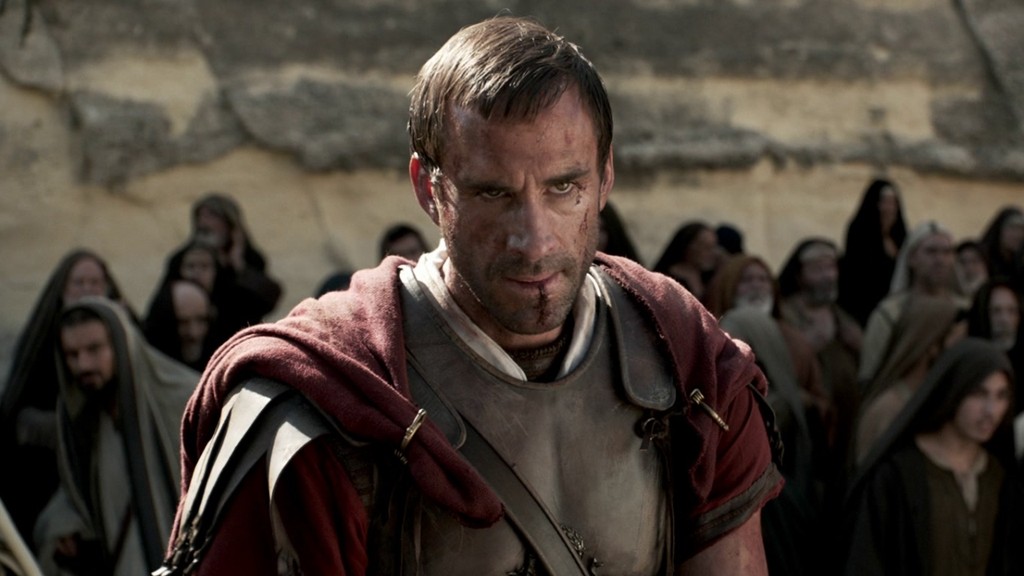
12002344_512182395615185_497958511845252694_o

According to distributor Sony Pictures Risen “follows the epic Biblical story of the resurrection, as told through the eyes of a non-believer. Clavius, a powerful Roman Military Tribune, and his aide Lucius, are tasked with solving the mystery of what happened to Yahshua in the weeks following the crucifixion, in order to disprove the rumors of a risen Messiah and prevent an uprising in Jerusalem.”

Actually, the search only lasts a few days, because as Clavius, excellently played by Joseph Fiennes, points out, an identifiable body wouldn’t last longer than that.

The movie begins with Yahshua, played with a subtle happiness by Cliff Curtis (Fear the Walking Dead), still hanging on the cross. The film quickly becomes a procedural mystery as Clavius searches to uncover the truth behind the disappearance of the body. As he meets people who knew Yahshua, Clavius’ questions begin to change and he focuses on the message of the man.

The changes Clavius experiences symbolize the changes among some of us who study the message of Yahshua.

While the movie is historically, biblically, and theologically sound, the fanciful fictional scenes are immensely entertaining. For example:

The Zealot Barabbas tracked down and killed by the Romans less than two days after being pardoned by Pontius Pilate.

A Roman soldier saying his superior officer, the centurion, “wasn’t himself,” a day after witnessing the death of Yahshua.

When Clavius interrogates Yahshua’s follower, Bartholomew, who is giddy with the joy of Yahshua, the apostle appears as though, as scripture says, “he’s drunk on new wine.” As he leaves the Roman garrison, Bartholomew, played by Stephen Hagan, waves goodbye happily.

After being cut by a Roman solder, Simon throws the sword away and offers water and food to his former enemy.

Directed and co-written by Kevin Reynolds (The Count of Monte Cristo, Waterworld) the production values of the $20 million motion picture are first rate. The locations, costumes, props, and historical accuracy are all excellent. And everyone speaks in a slightly British accent, as we’ve come to expect from movies like this. (I’m only slightly kidding.)

The tone of the film could be described as playful or lighthearted, different than most Biblical releases. But as a follower of Yahshua, I found the tone reflects the joy and love of Yahshua.

When we encounter him, we are changed, the characters tell us, as they project the pure happiness of Yahshua. They love, because God loves us.

Juxtapose this with God’s Not Dead 2. While I’ve not seen it, the preview I sat through was enough.

“I would rather stand with God and be judged by the world, than stand with the world and be judged by God,” said a public school teacher being criticized for talking about Jesus in her classroom.

“If we sit by and do nothing, the pressure that we’re feeling today will mean persecution tomorrow. We’re at war,” said a Christian in response to the criticism.

Christians in God’s Not Dead 2 are striving to change their culture.

In Risen, Yahshua and his followers are outside the culture, striving to change people’s hearts.

A follower of Yahshua tells the ruling authority, “you’ve already lost,” when facing the prospect of stopping the followers of Yahshua.

Bartholomew throws up his hands, drops to his knees, and is prepared to die for Yahshua.

The Christians in God’s Not Dead 2 appear prepared to demand the government comport to their views.

Risen is the rare sort of movie, and story, that keeps you thinking hours, days, weeks later.

We intend to buy the movie and watch it again and again.

God’s Not Dead 2 has a message that unfortunately we hear again and again – a message that clearly isn’t the message of Yahshua.
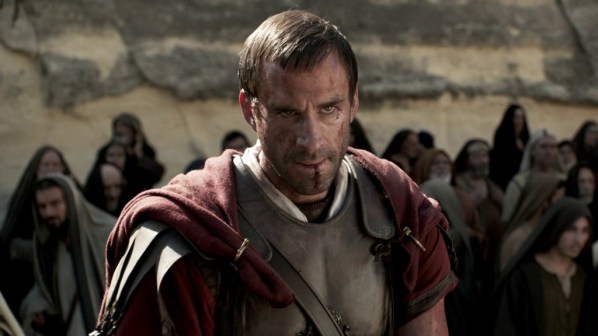
Joseph Fiennes in Risen.

Joseph Fiennes in Risen.

To order the movie, visit this link: http://amzn.to/2uGk4fQ.
Posted in culture, Faith, in the news | Tagged , , , , , , | Leave a comment